
Risk and Capital Controls. Capital Preservation. Structural Control
Risk and Capital Controls
At Rexwood Capital, risk is not an afterthought; it is the foundation of every mandate deployed under the REX Framework. We operate through predefined drawdown thresholds, disciplined capital allocation, liquidity segmentation, and structural ring-fencing mechanisms designed to preserve capital integrity across all capital deployment layers.

Risk Philosophy
- Preservation precedes expansion
- Exposure is structured, not reactive
- Risk is quantified before capital is deployed
Every mandate whether Managed Account allocation, Hybrid SPV-based allocation, or Wealth Management mandate operates within predefined capital tolerance bands.

Multi-Layer Risk Architecture
Our risk and capital controls operates through a structured, multi-layer control architecture designed to align capital exposure, liquidity parameters, and mandate calibration before and during deployment.
The framework below illustrates how capital flows through defined control checkpoints, ensuring preservation, segmentation, and continuous oversight across all capital deployment tiers
While controls are predefined, market volatility and systemic risk factors may influence outcomes beyond modeled thresholds.
Rexwood Capital Risk & Capital Governance Framework

Portfolio-Level Controls
- Tier-specific maximum drawdown parameters
- Diversification across instruments and mandate categories
- Exposure caps per instrument and sector
- Volatility-adjusted position sizing
Structural Segmentation
For Capital Appreciation mandates, capital is segmented between
- Tier-specific maximum drawdown parameters
- Diversification across instruments and mandate categories
Liquidity Governance
Liquidity is defined per mandate and may include:
- Monthly liquidity windows
- Quarterly withdrawal cycles
- SPV lock-up periods (1–3 years depending on mandate)
- Prior notice requirements for large redemptions
Liquidity alignment is formally documented within mandate agreements prior to capital activation.
Mandate Customization Controls
For Institutional and UHNW mandates:
- Drawdown limits are customized
- Allocation ratios are adjustable
- Capital efficiency modeling is applied
- Liquidity frameworks are tailored
Capital Deployment Protocol
Before capital is activated:
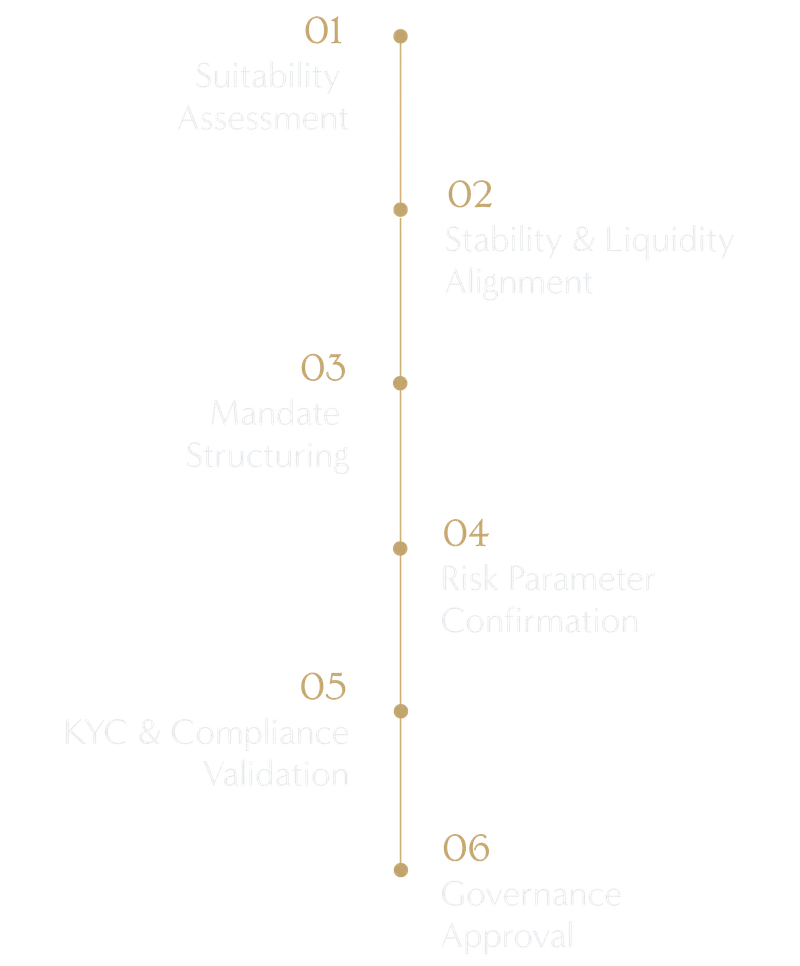
Capital deployment occurs only upon formal governance approval. This ensures structural integrity from mandate admission through portfolio execution.

Monitoring & Oversight
- Real-time portfolio monitoring
- Floating and realized drawdown tracking
- Risk-adjusted performance analysis
- Performance attribution reviews
- Quarterly mandate reviews (Institutional tiers)
Risk metrics are monitored continuously and reviewed under structured oversight cycles.
Risk Escalation & Mitigation Protocol
If predefined risk thresholds are approached:
- Exposure Adjustments Are Executed
- Position sizing is recalibrated
- Liquidity buffers are preserved
- Mandate review may be initiated
This ensures proactive control rather than reactive intervention.
Mitigation measures are executed within operational capacity and may not fully mitigate exposure under extreme market dislocations.

Governance Integrity
Rexwood Capital does not represent immunity from market volatility. Our governance commitments include:
- Defined exposure
- Transparent reporting
- Tier-aligned drawdown bands
- Structural capital separation
- Institutional review mechanisms
- Risk is defined.
- Control parameters are structured.
- Capital integrity is preserved through governance.
Before engaging any mandate under the REX Framework, we conduct a structured risk calibration process to ensure mandate suitability and capital stability alignment.
All engagements are subject to suitability assessment, stability evaluation, compliance verification, and formal mandate documentation prior to activation.
Help Center
Risk Disclosure
All investments involve risk, including the potential loss of capital. Performance projections are indicative and not guaranteed. Drawdown parameters represent target control thresholds and may vary based on market conditions and mandate structure.
Liquidity terms are defined within each individual mandate agreement. SPV allocations may be subject to defined lock-up periods and structural investment terms. Access to certain mandates may be restricted in specific jurisdictions in accordance with applicable regulatory requirements. Rexwood Capital operates under a disciplined investment framework; however, past performance does not guarantee future results.